Wednesday, February 19, 2014

Do-It-Yourself Backpack Dinners

I love to eat. Hey, who doesn't! Puttering around in the kitchen, mixing ingredients like a mad chemist, is my idea of a good time. But my creativity got stretched to the limit when I was helping my oldest son plan an extended backpack trip last summer.

He needed food that was light, cheap, and was going to keep the fires of his raging metabolism going while he traveled the back country of Washington for as much as a week at a time. He needed protein, carbohydrates, and enough vitamins and minerals to keep him going.

Tor Bertin in the Washington Cascades
Some backpackers might just head to REI and stock up on ready-to-eat meals - but I try to "do it myself" whenever possible. Prepackaged backpacking food can cost as much as eating in a fancy restaurant, with much less deliciousness!

The biggest problem we faced was packing enough protein for him. To address the issue, we bought a used food dehydrator (the kind that was popular in the early 1980s), and proceeded to learn about food dehydration.
Did you know that you can dehydrate hamburger? I guess it shouldn't surprised me - I am, after all, a big beef jerky fan - but for some reason I was just delighted with the knowledge that you could fry up a huge batch of hamburger, dry it and package it, and rehydrate it high up on some mountain for a soup or stew. Here's how you do it: First, fry the hamburger until it is well browned, and drain the oil from it. Rinse the hamburger repeatedly under hot water until there is no oil left (oil will make the meat rancid). When the meat is grease-free, dry between two paper towels, and place in the dehydrator. Dry and package. Boom! Instant hamburger.

We dehydrated cooked noodles to give him quick-cook pasta (similar to instant rice), found bags of dried apricots, and made big bags of homemade trail mix. My favorite concoction involved instant mashed potatoes, hamburger, dried onions, sliced carrots, spices and garlic for an instant, potato-y blast of carbohydrate goodness. My son reported that the burger was rather bland and tasteless, but still made for good eating at 10,000 feet.

I started thinking about these homemade backpacking preparations when I ran across a list of Army MREs (Meals Ready to Eat) from around the world. The food in the packages for each county has a special... shall I say, flavor... unique to that part of the world. Very interesting! Here's a peek at some  NON homemade meals. I think the French one looks the most delicious - go figure!
http://www.foodbeast.com/2014/02/19/this-is-what-army-food-rations-look-like-around-the-world/This is what Army food rations look like around the world...

Tuesday, February 18, 2014

Keeping My Sunny Side Up: Napping Boosts Brain Power

Keeping My Sunny Side Up: Napping Boosts Brain Power: Short naps in the middle of the day can increase productivity by more than 30 percent.

Napping Boosts Brain Power


Hello, and Happy Tuesday! After taking a break from writing on President's Day, I'm back at it, and also back at work. Topic for the day: naps!


Young mothers often get the advice that they should sleep when their baby sleeps. Having long been an inveterate napper, this sounded like great advice to me. I made my youngest son take naps until he was 9 years old - at which time it occurred to me that I COULD nap without him. I did so.


As far as I'm concerned, there's nothing quite like a little nap over the lunch hour to refresh and rejuvenate. I used to sneak out to my old pickup truck during lunch and take a 20-minute snooze in the cab. I always - well, ALMOST always - woke up in plenty of time to go back to work. There WAS that one time when my boss woke me up by rapping on the window... hmm.

Anyway, I feel lucky that naps are part of my sleep repertoire. I've always thought that countries for whom the nap was a regular part of the daily routine really were onto something. It turns out that there is a biological need for sleep in the middle of the day - not necessarily the two-hour "siesta" favored by  hot countries (darn!), but a short nap leaves people feeling refreshed and rejuvenated. It turns out that humans are what is called "bi-phasic" - that is, evolutionarily designed to need more than one period of sleep.

The mid-afternoon nap has a long history. In Roman times, a regular nap was considered a physical necessity. Islamic law actually included the nap as part of a necessary health routine. The Spanish developed the two-hour siesta to allow agricultural workers to avoid working during the hottest part of the day.

Modern research has showed that short mid-afternoon naps improve productivity, reduce burnout and increase learning ability. Some businesses are taking advantage of this by creating nap rooms for their workers; there is even a company offering "nap pods" for workers. In 2007, the French health minister considered making an afternoon nap a legal right to French workers. In 2010, Japanese companies jumped on board the sleep train by encouraging workers to nap at work. Even in America, more and more companies are starting to offer employees a space for napping. Employees emerge with increased cognition and improved productivity.

Napping also reduces the chance of heart disease, although research also indicated that it increased the chance of Type 2 Diabetes.

So how long should our naps be? Research indicates that 10-20 minutes is all that is required to improve our productivity for the remainder of the day. Longer than that - between half an hour and an hour - can leave you groggy; if you are going to sleep longer than 20 minutes, you need at least 90 minutes to go through a full sleep cycle.

There are lots of sites that offer advice on how to nap for the best "brain benefits." Information at the following links will teach you how long to nap and what benefits  mid-day sleeping offers.

Siesta Awareness
How Long to Nap
Napping Benefits and Tips
Napping Dos and Don'ts...
The Science Behind Power Naps


Sunday, February 16, 2014

Keeping My Sunny Side Up: Real Beauty

Keeping My Sunny Side Up: Real Beauty: I grew up in the 1960s and 70s - young enough to have benefitted from the women's movement, but old enough to remember a time when women...

Real Beauty

I grew up in the 1960s and 70s - young enough to have benefitted from the women's movement, but old enough to remember a time when women were very much at the low end of the social pool. I can remember, as a child, thinking that it would be fun to be a stewardess (which we now call flight attendants). I wanted to be a stewardess, but I knew that at the time airlines had specific standards for their employees - and I knew I wasn't pretty enough. At the time, this did not strike me as an injustice - it just was the way it was. But looking back, I am outraged for that little girl who didn't think she was pretty enough to work on a plane and serve people drinks.


I am not what you might call a classical beauty. Some might argue that I'm not beautiful at all. I have a round face, a long pointed nose, and I'm 25 pounds overweight. Despite my husband's insistence that I am gorgeous, I have never really felt physically beautiful. Even when I was running 10 miles a day and weighed 125 pounds, when I had a body that some might call "rockin'," I did not think of myself as "hot."

So why are we so critical of ourselves as women? Why do we have a hard time seeing ourselves for the beautiful women we are? The way women are portrayed in the media has a lot to do with it. Tune in any television show on any channel, and the women are slender and gorgeous, with high cheekbones, tucked tummies and gorgeous long legs. Most television shows are centered on male characters, with the women playing supporting roles. The same holds true for movies. Although there are a few outstanding exceptions, like "Thelma and Louise," how many women action heroes do you know?

In magazines, the "cover girls" (why don't we have "cover boys"?) are Photoshopped within an inch of their lives, taking off pounds, removing blemishes and imperfections until they attain an unreachable - and unreasonable - standard of beauty. This video from Buzzfeed takes four normal women and gives them the star treatment - complete with Photoshopped beauty. Their reaction is interesting. One woman sums up the experience like this: "Once someone else has done your makeup, and someone else has done your hair, and then take away your imperfections, then there's not much left of who you really are."

And that is what we need to remember. Our imperfections are part of what makes us who we are. Nobody meets the standards of beauty expected by the modern media - not even the models who adorn magazine covers. So it's time to redefine that beauty. It's time to embrace our whole selves, complete with flaws. It's time to recognize that true beauty is a whole package.

The following are links to a couple videos that deal with women's body images. The first is the Buzzfeed video I referenced earlier. The second is a rather startling video from Dove about how women describe themselves. We are too hard on ourselves. Let's work on being a little kinder!

NORMAL WOMEN GET MAKEOVER

DOVE WOMEN'S SKETCHES

Saturday, February 15, 2014

Keeping My Sunny Side Up: Restoring Hope to the Garden of Eden

Keeping My Sunny Side Up: Restoring Hope to the Garden of Eden: Things are looking up for the place once known as “The Garden of Eden,” a lush oasis between the Tigris and Euphrates rivers. In the ...

Restoring Hope to the Garden of Eden

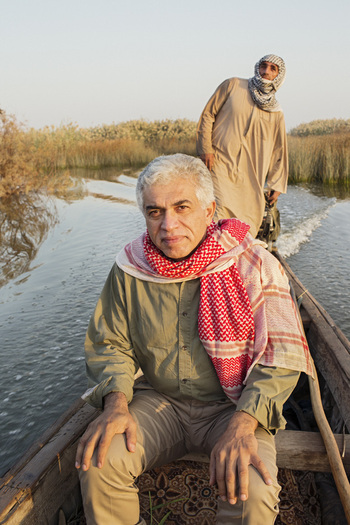
Things are looking up for the place once known as “The Garden of Eden,” a lush oasis between the Tigris and Euphrates rivers.

In the mid-1990s, Saddam Hussein drained the marshlands and poisoned the water as punishment against Shiite Arabs, who had rebelled against him after the Kuwait invasion. The rebels fled to the marshlands; Hussein followed and destroyed the area. The once-green landscape turned into a dusty wasteland, and the people who lived there, descendants of the ancient Sumerians,  were forced to seek other places to live. It was one more remnant of an ugly and poisonous regime, one more problem in a place already ravaged by decades of war.

Azzam Alwash, a civil engineer grew up in those wetlands. His father was in charge of the irrigation department, so as a young boy he spent many hours on the marshes. After Hussein fell, Alwash determined to return to his homeland from his new home in California. He was faced with a nearly impossible task: make environmental protection important in a land that was struggling with basic infrastructure issues like roads and water.

He founded Nature Iraq, a non-profit organization, and applied what he knew about hydraulic engineering to survey and restore the marshes. After the wetlands were reflooded, the previous residents returned to try to rebuild their lives. Iraq has its first-ever national park. Alwash continues to work on water issues throughout the Middle East.

For the full story on Azzam Alwash, click here: http://www.positivenewsus.org/iraqrsquos-first-ever-national-park.html